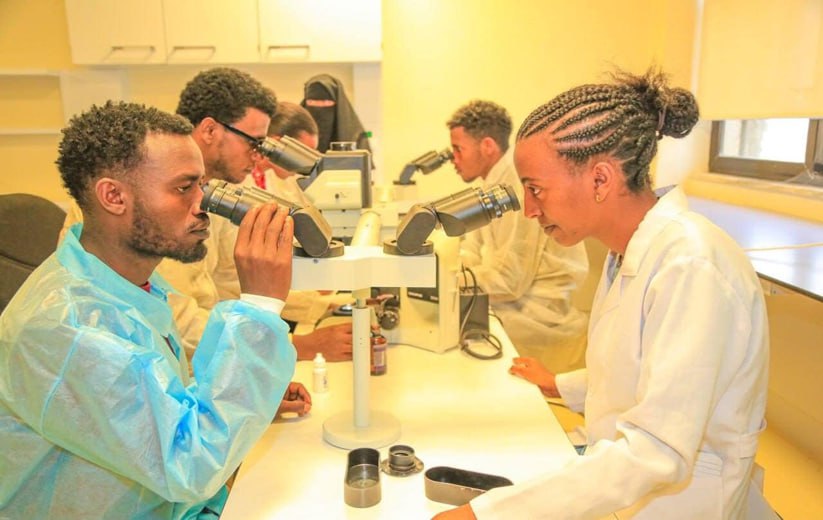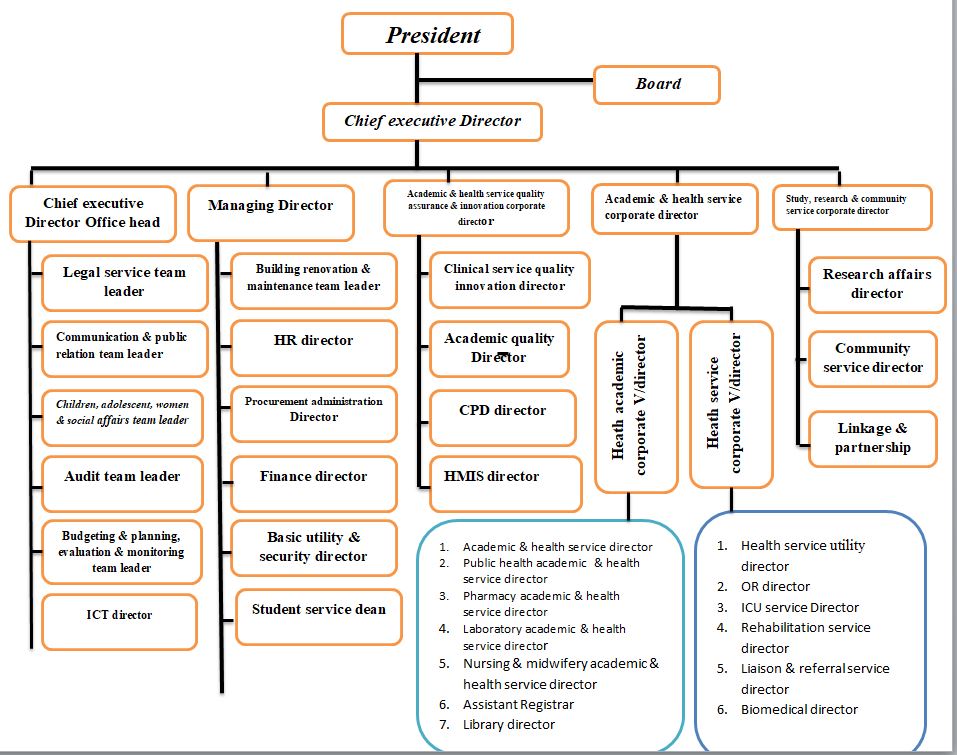
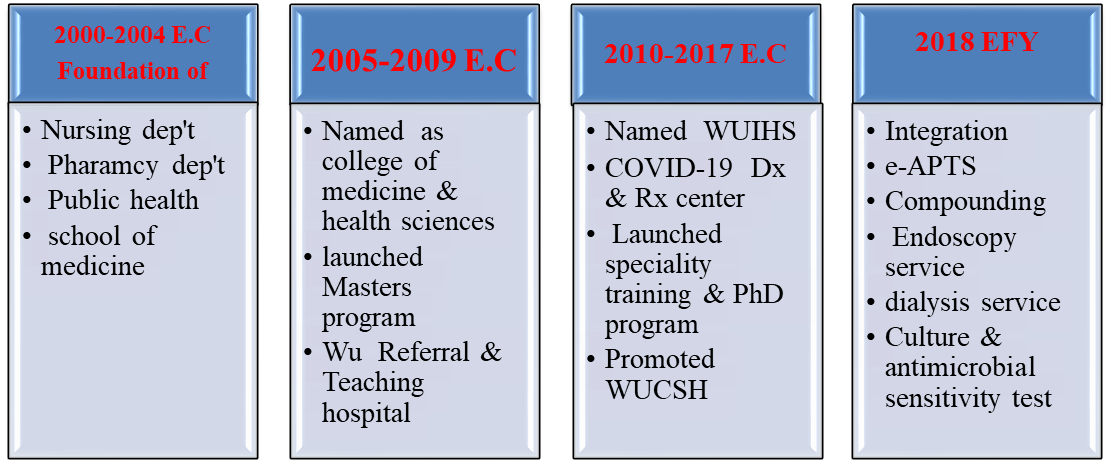
Wallaga university institute of health sciences was established in 2000E.C. as as faculty of health sciences by launching four programs namely Nursing, Pharmacy, Public health & medical laboratory. The faculty developed to college of medical and health science since 2005.E.C after opening different under & post graduate programs including midwifery in 2003, Medicine in 2004 and masters in public health in weekend programs.
The foundation for Wallaga university referral & teaching hospital was laid on Sene 19/1999 .E.C. by H.E. Abba Dula Gemeda former president Oromia National Regional state and the former speaker of F.D.R.E. house of peoples representative to adress western peoples health & health related problems. The hospital was innagurated on on Gimbot 3/2009 E.C. by H.E Obbo Lema Magarsa former president Oromia National Regional state & H.E Dr Dereje Duguma former Oromia Regional health Beauro & started providing clinical services as outpatient service,and inpatient services on 203 beds under four major departments by 72 health professionals & 6 admnistrative staffsLater on the college stepped up to institute of health sciences after it owned the referra hospital in 2010 E.C.
Background
The department of Public Health was established in 2008 by offering a BSc degree in health officer under the then College of Health and Medical Sciences (CHMS). The department aimed at producing competent and qualified graduates from the BSc. level to the terminal (third) degree levels to contribute to the ever-increasing health human resource needs of the public health sector in the country. The department has significantly contributed to the production of public health professionals that contribute to disease prevention, health promotion and treatment, educational programs, policy development, services administration, research, and regulatory services locally and internationally.
The department has passed through a series of transformational development, the then program of public health was transformed to the department of public health during 2015/16 and currently, the department is structured into five administrative divisions (three coordinating units namely human nutrition coordinating units, public health and health policy coordinating units, behavioral and health promotion coordinating units) and two program coordinators (PhD programs coordinator, undergraduate program coordinator). The department has been building capacities on the existing system to become accountable to lead the initiative of capacity building process through developing a common quality assurance framework of public health. After the transition, the department further strengthened teaching, research, and community services integrity using any available opportunities
The Department of Pharmaceutics and Supply Chain Management was established in 2022 with a mission to advance expertise in drug formulation and the logistical frameworks that ensure medicine reaches those in need.
We currently have 7 active lecturers facilitating our academic programs and Demonstrating our commitment to high-level expertise, two PhD students are currently on study leave, pursuing advanced doctoral research to further strengthen the department's research capacity upon their return.
Currently, the department specializes in a single, high-impact graduate program: MSc in Pharmaceutical Supply Chain Management. Since its inception in 2022, the department has seen consistent growth in its student intake: So, 23 MSc students have been enrolled in the program since 2022 and out of them 6 students successfully complete their MSc program. There are currently 17 MSc students actively engaged in their studies and research within the department.